How long to monitor postpartum blood pressure after delivery is up to your care team, but preeclampsia can occur as late as six weeks after birth. ACOG recommends a check soon after you go home, often within the first week. Your care team will tell you exactly what they want, and when.
You made it through delivery. But blood pressure isn't only a pregnancy story. It can rise, or show up as a problem for the first time, in the days and weeks after birth, even if every reading during pregnancy was normal.
That's not meant to worry you. Most cases settle on their own, and tracking through this window is a precaution, not a sign something is wrong. It's also why home monitoring deserves your attention now: the research on this exact period is some of the strongest evidence Connura draws on.
Can Blood Pressure Go Up After Giving Birth?
Yes, blood pressure can go up after giving birth. It can rise, or show up as a problem for the first time, in the days and weeks after birth, even if every reading during pregnancy was normal.
Many clinicians describe the roughly 12 weeks after birth as the "fourth trimester," a recovery period that deserves its own attention, not just a single six-week checkup.¹ Blood pressure is part of that. It can appear for the first time after delivery, even in women with no signs during pregnancy. The highest-risk window is the first days to weeks postpartum.¹ That's why your care team may keep asking about it even after you've gone home. It's an active part of postpartum recovery.
What Is Postpartum Preeclampsia, and What Are the Symptoms?
Postpartum preeclampsia symptoms include a headache that won't go away, vision changes, and pain in your upper belly. Sudden swelling, nausea, or trouble breathing are signs too. Call your care team the same day for any of these, even weeks after birth. Get emergency help right away for a seizure, chest pain, severe shortness of breath, or fainting.
Preeclampsia that develops after delivery is called postpartum preeclampsia. It most often appears in the first week, but can occur as late as six weeks postpartum, even after a fully normal pregnancy.² It's worth knowing the signs below either way.
This is also the reasoning behind a common piece of guidance: ACOG recommends a blood pressure check soon after you go home, often within the first week, sooner if you had high blood pressure in pregnancy.¹ That's ACOG's general recommendation for the follow-up window, not a rule for what any single reading of yours means. Your care team will tell you exactly what they want, and when.
Warning Signs: Call Right Away, Whatever Your Numbers
Some things matter regardless of your reading. Call your care team the same day for any of these, even weeks after birth²:
- A headache that won't go away
- Vision changes: blurry vision, spots, or flashing lights
- Pain in your upper belly, under your ribs
- Sudden swelling, nausea, or trouble breathing
A reading at or above 160/110, or any of the symptoms above, means contact your provider now, even if you feel otherwise fine. Get emergency help right away for a seizure, chest pain, severe shortness of breath, or fainting.²
Why Tracking at Home After Delivery Works So Well
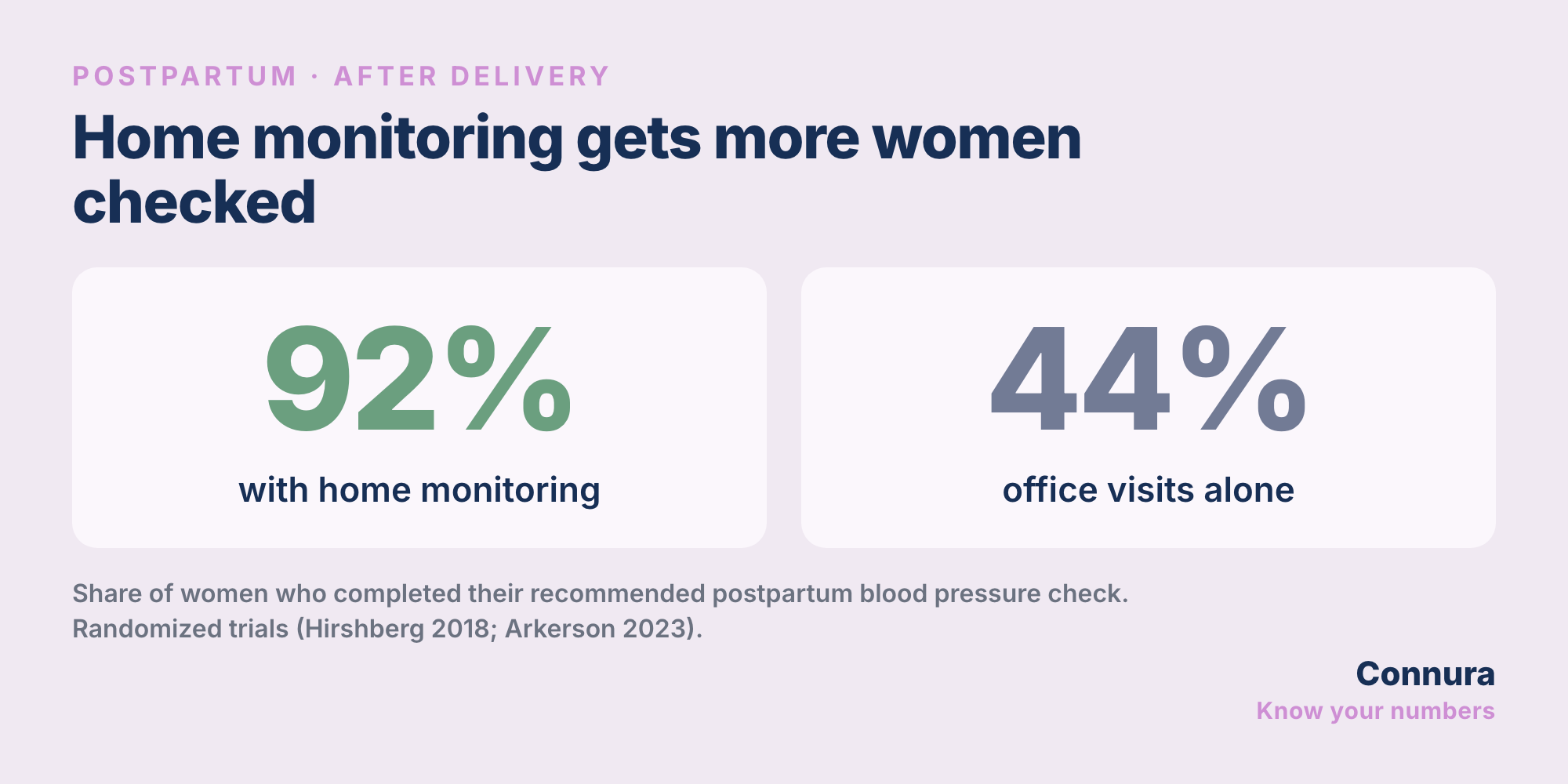
Postpartum is where the evidence for home monitoring is strongest. Two randomized trials found women using it completed their recommended check far more often than with office visits alone: 92% vs. 44% in one, 92% vs. 58% in the other.³ ⁴ It also may narrow a documented equity gap. In one trial, Black patients had lower follow-up with office visits alone (41% vs. 70% for white patients), but that gap disappeared with home monitoring (93% vs. 93%). A broader review confirmed the same pattern, roughly halving the disparity.⁴ ⁵
Several studies, including a meta-analysis of over 5,000 women, also linked home monitoring to fewer hypertension-related readmissions, with no increase in adverse outcomes for mother or baby.⁵ ⁶ Most women in one study expected daily checks to raise their anxiety. Instead, they found the opposite: one described it as what made her "really calm."⁷
One honest limit: this evidence shows home monitoring gets more women checked and may reduce readmissions. It is not proven to prevent postpartum preeclampsia or lower maternal mortality on its own.⁵ ⁶ It works best paired with a plan, not as a replacement for one.
Work With Your Care Team
Your care team is the best source for what your numbers mean for you postpartum. Always follow the guidance they've already given you about which readings and symptoms should prompt a call. If they haven't talked with you yet, ask at your next appointment so you both know what to watch for.
Once you have that plan, you'll be able to enter those thresholds in Connura when it launches late 2026 and see a status label for each reading, based on the ranges right for you (not a generic chart). You'll be able to generate a report anytime to share with your team. Connura won't decide your plan; it will help you follow the one you built together.
Frequently Asked Questions
Is it normal for blood pressure to go up after having a baby?
It can happen, even after a completely normal pregnancy. The first days to weeks after birth are the highest-risk window. Most cases settle on their own, but tracking is a smart precaution, and any warning symptom or a reading at or above 160/110 deserves a call right away.
How long should I keep checking my blood pressure after delivery?
Follow the specific plan your care team gives you. As general guidance, ACOG recommends a check soon after you go home (often within the first week, sooner if you had high blood pressure in pregnancy), with postpartum preeclampsia risk extending to about six weeks.
Does home blood pressure monitoring after birth help?
Yes, for getting the follow-up you need. Randomized trials found 91–92% of women completed their recommended check using home monitoring, versus 44–58% with office visits alone, and several studies link it to fewer readmissions. It hasn't been shown to prevent preeclampsia itself. It helps make sure problems are caught and followed up on.
References
- American College of Obstetricians and Gynecologists (ACOG). Optimizing Postpartum Care. Committee Opinion No. 736. 2018. https://www.acog.org/clinical/clinical-guidance/committee-opinion/articles/2018/05/optimizing-postpartum-care
- Preeclampsia Foundation. Signs and Symptoms (including postpartum). https://www.preeclampsia.org/signs-and-symptoms
- Hirshberg A, Downes K, Srinivas S. Comparing standard office-based follow-up with text-based remote monitoring in the management of postpartum hypertension: a randomised clinical trial. BMJ Quality & Safety. 2018;27(11):871-877. https://doi.org/10.1136/bmjqs-2018-007837
- Arkerson BJ, Finneran MM, Harris SR, et al. Remote Monitoring Compared With In-Office Surveillance of Blood Pressure in Patients With Pregnancy-Related Hypertension: A Randomized Controlled Trial. Obstetrics & Gynecology. 2023;142(4):855-861. https://doi.org/10.1097/AOG.0000000000005327
- Steele DW, Adam GP, Saldanha IJ, et al. Postpartum Home Blood Pressure Monitoring: A Systematic Review. Obstetrics & Gynecology. 2023;142(2):285-295. https://doi.org/10.1097/AOG.0000000000005270
- Albadrani M, Tobaiqi M, Al-Dubai S. An evaluation of the efficacy and the safety of home blood pressure monitoring in the control of hypertensive disorders of pregnancy in both pre and postpartum periods: a systematic review and meta-analysis. BMC Pregnancy and Childbirth. 2023;23:550. https://doi.org/10.1186/s12884-023-05663-w
- Cairns AE, Tucker KL, Crawford C, McManus RJ, Powell J. Implementing self-management: a mixed methods study of women's experiences of a postpartum hypertension intervention (SNAP-HT). Trials. 2020;21(1):508. https://doi.org/10.1186/s13063-020-04394-z
Connura provides educational information. It does not measure blood pressure and does not replace medical care. In an emergency, call 911 (or your local emergency number).
Connura is not a medical device and is not intended to diagnose, treat, or replace medical care. Always consult your healthcare provider for medical advice.