How often to check your blood pressure during pregnancy depends on the plan your care team gives you. There's no single frequency that's right for everyone. As a general reference point, most research studies had participants check about once or twice a day. But your provider's guidance for your specific pregnancy comes first.
You check your blood pressure, the number looks fine, and you feel a wave of relief. Then the next reading looks a little different, and you're not sure what to think. It's a common moment. Blood pressure isn't a single fact about you. It moves throughout the day, for lots of ordinary reasons.
That's exactly why one reading was never meant to carry the whole story. What actually helps your care team is the pattern: the readings you build up over days and weeks. This guide covers why that pattern matters more than any one number, what the evidence says about tracking consistently, and how to build the habit without chasing perfection.
One Reading Is a Snapshot
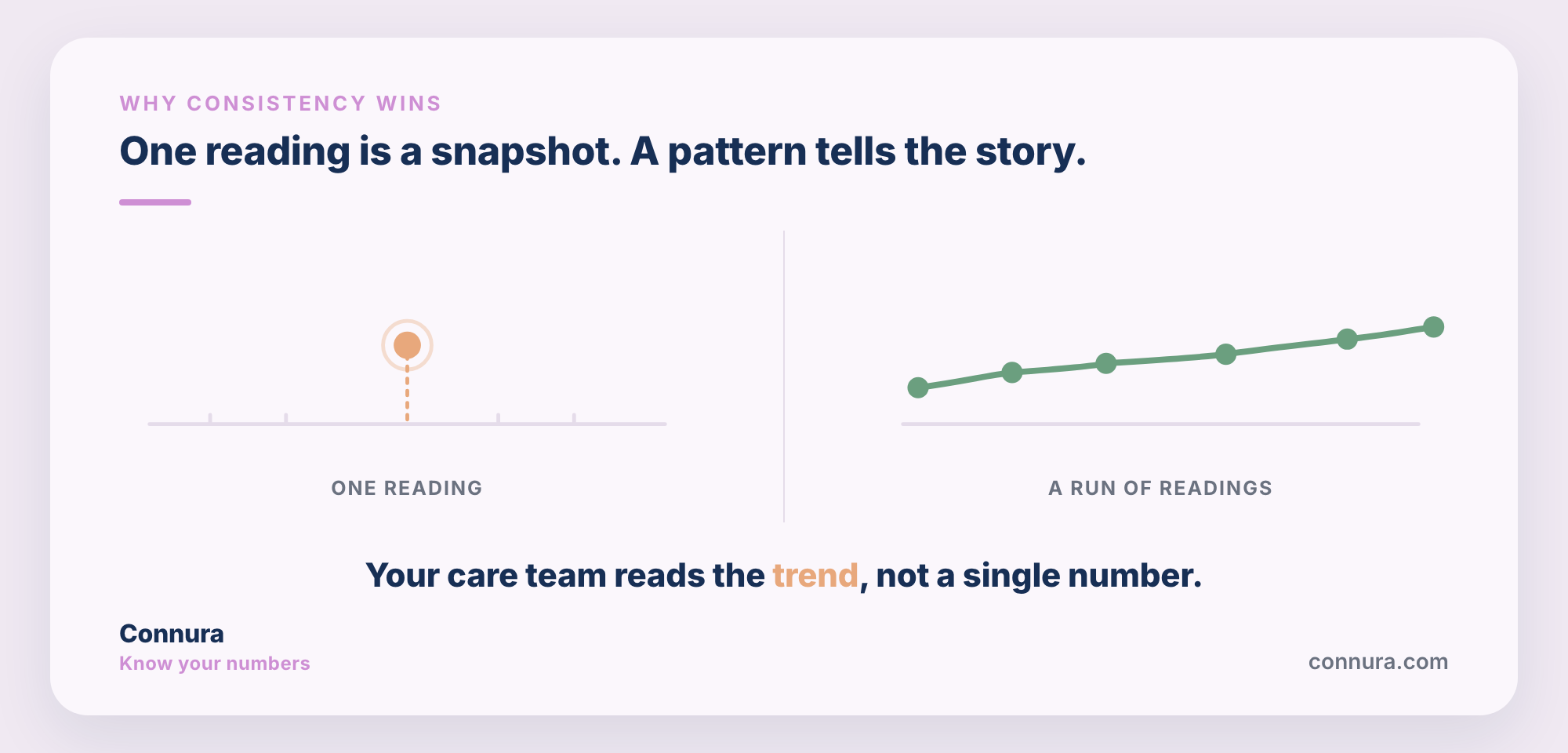
A single blood pressure check captures one moment. How you slept, whether you just climbed stairs, whether you're mid-conversation, even whether your bladder is full: all of it can nudge a reading up or down. None of that means anything is wrong. It just means one number, by itself, is a weak witness.
What your care team actually relies on is the trend across many readings. A pattern smooths out the noise from any single moment. It shows what your blood pressure is actually doing over time: rising, steady, or coming back down. That's something a single clinic visit, weeks apart, simply can't capture.
What the Evidence Says About Tracking at Home
This has been studied directly. A secondary analysis of the OPTIMUM-BP trial found that home readings from pregnant women with hypertension closely matched their clinic readings, with average differences of well under 4 mmHg on both the top and bottom numbers.¹ In other words, when you check your blood pressure at home with a validated monitor and good technique, the number you get is trustworthy. It's not a lesser substitute for what your provider would measure.
A larger systematic review pooled more than a dozen studies and thousands of pregnant and postpartum women. It found that home blood pressure monitoring was, overall, at least as safe as clinic-only monitoring, with no added risk to mother or baby.² That review is also a useful guardrail on what the evidence doesn't show: home monitoring on its own hasn't been shown to prevent preeclampsia, and it isn't a replacement for your scheduled prenatal visits.² Its real, evidence-backed value is what it adds between those visits: a fuller picture your care team can use, not a way to diagnose yourself at home.
Consistency, Not Perfection
Here's the reassuring part: you don't need a flawless log for a pattern to be useful. In the OPTIMUM-BP analysis, women checked their blood pressure on a median of 77–85% of days, not every single day, and that was still enough to build a meaningful, clinically useful picture.¹ A large UK trial of self-monitoring in higher-risk pregnancy found similarly high real-world engagement, with most participants following their monitoring schedule the large majority of the time.³
The takeaway: missing a day here and there doesn't break the pattern. What builds it is showing up regularly and logging what you actually measure, including the normal readings, not just the ones that worry you. Then let the trend accumulate. That's the habit Connura is being built to support.
How Often Should You Check?
There's no single "correct" frequency that applies to every pregnancy. The research hasn't identified one best schedule, and your care team is in the best position to set the frequency that fits your specific situation. As a general reference point, most research studies asked participants to check roughly once or twice a day.¹ ³ But your own plan, set by your provider, is the one to follow.
If you haven't talked with your care team about how often they'd like you checking, it's worth raising at your next appointment. Once you have that plan, Connura will help you follow it and keep every reading in one place, so the pattern is ready whenever your provider wants to see it.
Work With Your Care Team
Your care team is the best source for what your numbers mean for you. Always follow the guidance they've already given you about which readings and symptoms should prompt a call. If you haven't had that conversation yet, it's worth raising at your next appointment, so you both know what to watch for going forward.
Once you have that plan, you'll be able to enter those thresholds in Connura when it launches late 2026. You'll see a status label for each reading, based on the thresholds your care team sets rather than a generic chart, and you'll be able to generate a report anytime to share your readings with your team. Connura won't decide your plan. It will help you follow the one you built together.
Frequently Asked Questions
How often should I check my blood pressure during pregnancy?
There's no single frequency that's right for everyone. Follow the plan your care team gives you. As a general reference point, most research studies had participants check about once or twice a day, but your provider's guidance for your specific pregnancy comes first.
Is it okay if I miss a day or two of tracking?
Yes. Research on home monitoring in pregnancy found that women who checked on roughly 77–85% of days still built a useful, meaningful pattern.¹ Consistency over time matters far more than a perfect streak. Just pick back up where you left off.
Can I really trust a reading I take at home, or does it need to be at the doctor's office?
Home readings taken with a validated monitor and good technique closely match clinic readings. One study found average differences of less than 4 mmHg.¹ A single home reading still deserves the same context as any other: it's most useful as part of your ongoing pattern, not read in isolation. A reading at or above 160/110, or any warning symptom, deserves a call right away regardless of the pattern.
References
- Bowen L, Pealing L, Tucker K, McManus RJ, Chappell LC. Adherence with blood pressure self-monitoring in women with pregnancy hypertension, and comparisons to clinic readings: A secondary analysis of OPTIMUM-BP. Pregnancy Hypertension. 2021;25:68–74. https://doi.org/10.1016/j.preghy.2021.05.016
- Albadrani M, Tobaiqi M, Al-Dubai S. An evaluation of the efficacy and the safety of home blood pressure monitoring in the control of hypertensive disorders of pregnancy in both pre and postpartum periods: a systematic review and meta-analysis. BMC Pregnancy and Childbirth. 2023;23:550. https://doi.org/10.1186/s12884-023-05663-w
- Tucker KL, Mort S, Yu LM, et al. Effect of Self-monitoring of Blood Pressure on Diagnosis of Hypertension During Higher-Risk Pregnancy: The BUMP1 Randomized Clinical Trial. JAMA. 2022;327(17):1656–1665. https://doi.org/10.1001/jama.2022.4712
- American Heart Association. Monitoring Your Blood Pressure at Home. 2024. https://www.heart.org/en/health-topics/high-blood-pressure/understanding-blood-pressure-readings/monitoring-your-blood-pressure-at-home
- American College of Obstetricians and Gynecologists (ACOG). Gestational Hypertension and Preeclampsia. ACOG Practice Bulletin No. 222. Obstetrics & Gynecology. 2020;135(6):e237–e260. https://www.acog.org/clinical/clinical-guidance/practice-bulletin/articles/2020/06/gestational-hypertension-and-preeclampsia
Connura provides educational information. It does not measure blood pressure and does not replace medical care. In an emergency, call 911 (or your local emergency number).
Connura is not a medical device and is not intended to diagnose, treat, or replace medical care. Always consult your healthcare provider for medical advice.