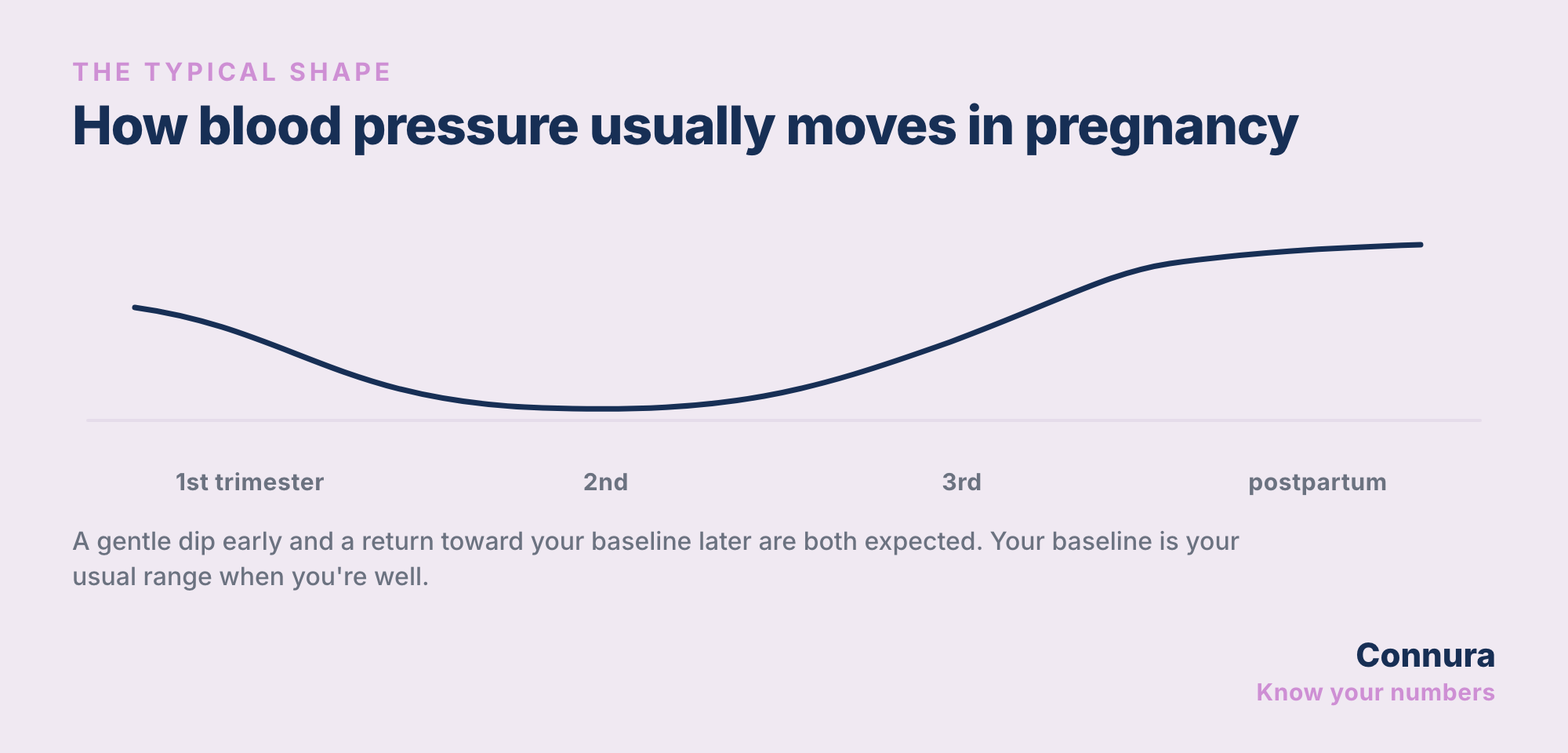
For many women, blood pressure runs a little lower than their non-pregnant baseline in the first and second trimesters. It typically climbs back up, often close to your pre-pregnancy baseline by the third trimester. The thresholds ACOG uses for elevated and severe blood pressure in pregnancy don't shift with the trimester.
Maybe your reading at 16 weeks was lower than it was at your very first prenatal visit, and you're wondering if that's a good sign or a warning sign. Or maybe you're further along, and the numbers are creeping back up toward where they started. That feels unsettling after months of lower readings. Either way, you're noticing a real pattern. Pregnancy changes how your blood pressure behaves, in a fairly predictable shape, at a fairly predictable time.
This article walks through that shape: what tends to happen trimester by trimester, and in the early weeks after birth. It also explains why the pregnancy-specific thresholds your care team uses don't change, even though your own numbers do. It's background for understanding your own trend, not a tool for deciding on your own what a given reading means. That decision belongs to you and your care team, together.
The First and Second Trimesters: A Gentle Dip
Early in pregnancy, your blood vessels relax and widen to support the growing blood supply your body needs. This is a normal, expected adaptation, not a problem to fix. For many women, this shows up as blood pressure that runs a little lower than their usual, non-pregnant baseline through the first and second trimesters.¹ It's one reason a reading that would look "low" outside of pregnancy is often nothing to worry about while you're pregnant. Your body is doing exactly what it's supposed to.
"Your baseline" just means your usual range when you're healthy and not pregnant. Knowing roughly what that number looks like for you (even a rough sense from a past checkup) makes it easier to recognize when something shifts later on, in either direction.
The Third Trimester: Returning Toward Baseline
As pregnancy progresses, blood pressure typically climbs back up, often returning close to your pre-pregnancy baseline by the third trimester.¹ This is also expected. It doesn't mean your risk has changed just because the number moved. What matters is whether a rise crosses into the ranges your care team watches for, or comes with symptoms.
That's the key idea to hold onto: the shape of this curve (dip, then return) is common and expected. The thresholds ACOG uses to define elevated and severe blood pressure in pregnancy don't shift with the trimester. A reading of 140/90 or higher is still information your care team wants at 12 weeks, at 30 weeks, or at 39 weeks.³ A reading of 160/110 or higher is still the severe range, at any stage, and still means contacting your provider right away.
After Delivery: The Rise Can Start Within the First Week
The pattern doesn't end at delivery. Blood pressure often rises again in the days after birth. For some women, that rise can be the first time a reading enters the elevated or severe range, even if pregnancy itself was uneventful. Research tracking postpartum blood pressure has found it commonly worsens in a window roughly three to nine days after delivery, which is exactly when many women are already home and no longer being checked daily.²
This is part of why ACOG's guidance on postpartum care emphasizes early, structured follow-up rather than waiting for the standard six-week visit.⁴ It's also why a reading that looks fine at hospital discharge doesn't rule out a rise later that same week. The trend still matters, and the same thresholds (140/90 elevated, 160/110 severe) still apply.
The Warning Symptoms That Don't Wait for a Number
Some symptoms deserve a same-day call no matter what your reading shows, at any point in pregnancy or after delivery:
- A headache that won't go away
- Vision changes: blurry vision, spots, or flashing lights
- Pain in your upper belly, under your ribs
- Sudden swelling in your face or hands
- Shortness of breath
And one number stands on its own, independent of trend or trimester: 160/110 or higher means call your provider right away.
Work With Your Care Team
Your care team is the best source for what your numbers mean for you at each stage. Always follow the guidance they've already given you about which readings and symptoms should prompt a call. If you haven't had that conversation yet, it's worth raising at your next appointment, so you both know what to watch for going forward.
Once you have that plan, you'll be able to enter those thresholds in Connura, which launches late 2026. You'll see a status label for each reading, based on the thresholds your care team sets rather than a generic chart, and you'll be able to generate a report anytime to share your readings with your team. Connura won't decide your plan; it will help you follow the one you built together.
Frequently Asked Questions
My blood pressure was lower in my second trimester and now it's climbing back up in my third. Is that a problem?
On its own, no. A return toward your pre-pregnancy baseline in the third trimester is a common, expected pattern. What matters is whether a reading crosses 140/90 or higher, or 160/110 or higher, or comes with a warning symptom. Your care team is the one who can tell you what a specific rise means for you.
Why does my blood pressure sometimes rise after I've already given birth?
Your body is still adjusting in the days after delivery. Blood pressure can climb again during that window, commonly somewhere in the first week to ten days. That's why many care teams check in earlier than the standard six-week postpartum visit, and why home monitoring in those first days can be useful.
Do the 140/90 and 160/110 thresholds change depending on how far along I am?
No. ACOG's thresholds for elevated (140/90+) and severe-range (160/110+) blood pressure apply the same way in every trimester and after delivery. What changes is your own baseline number over time, not the lines your care team is watching for.
References
- American Heart Association. Understanding Blood Pressure Readings. 2024. https://www.heart.org/en/health-topics/high-blood-pressure/understanding-blood-pressure-readings
- Hauspurg A, Jeyabalan A. Postpartum preeclampsia/eclampsia: Defining its place and management among the hypertensive disorders of pregnancy. Am J Obstet Gynecol. 2022;226(2 Suppl):S1211–S1221. doi:10.1016/j.ajog.2020.10.027
- American College of Obstetricians and Gynecologists (ACOG). Gestational Hypertension and Preeclampsia. ACOG Practice Bulletin No. 222. Obstetrics & Gynecology. 2020;135(6):e237–e260. https://www.acog.org/clinical/clinical-guidance/practice-bulletin/articles/2020/06/gestational-hypertension-and-preeclampsia
- American College of Obstetricians and Gynecologists (ACOG). Optimizing Postpartum Care. Committee Opinion No. 736. 2018. https://www.acog.org/clinical/clinical-guidance/committee-opinion/articles/2018/05/optimizing-postpartum-care
Connura provides educational information. It does not measure blood pressure and does not replace medical care. In an emergency, call 911 (or your local emergency number).
Connura is not a medical device and is not intended to diagnose, treat, or replace medical care. Always consult your healthcare provider for medical advice.