
The blood pressure cuff size you need during pregnancy depends on your arm: ACOG recommends a cuff about 1.5 times your upper arm circumference. Measure around the middle of your upper arm with a soft tape measure, then match that number to the cuff-size range on the box. Size up if you're near the edge of a range.
Standing in the pharmacy aisle, or scrolling a dozen options online, it's easy to grab whatever monitor looks trustworthy and has good reviews. But not every blood pressure monitor is built or tested for pregnancy. The wrong cuff size can throw a reading off by enough to matter. The good news: getting this right takes about ten minutes, one time.
This guide walks you through what to look for in a monitor, how to get the cuff size right, and how to set it up so your readings are ones your care team can rely on. It covers device and technique, not what any single number means for you.
What to Look For in a Monitor
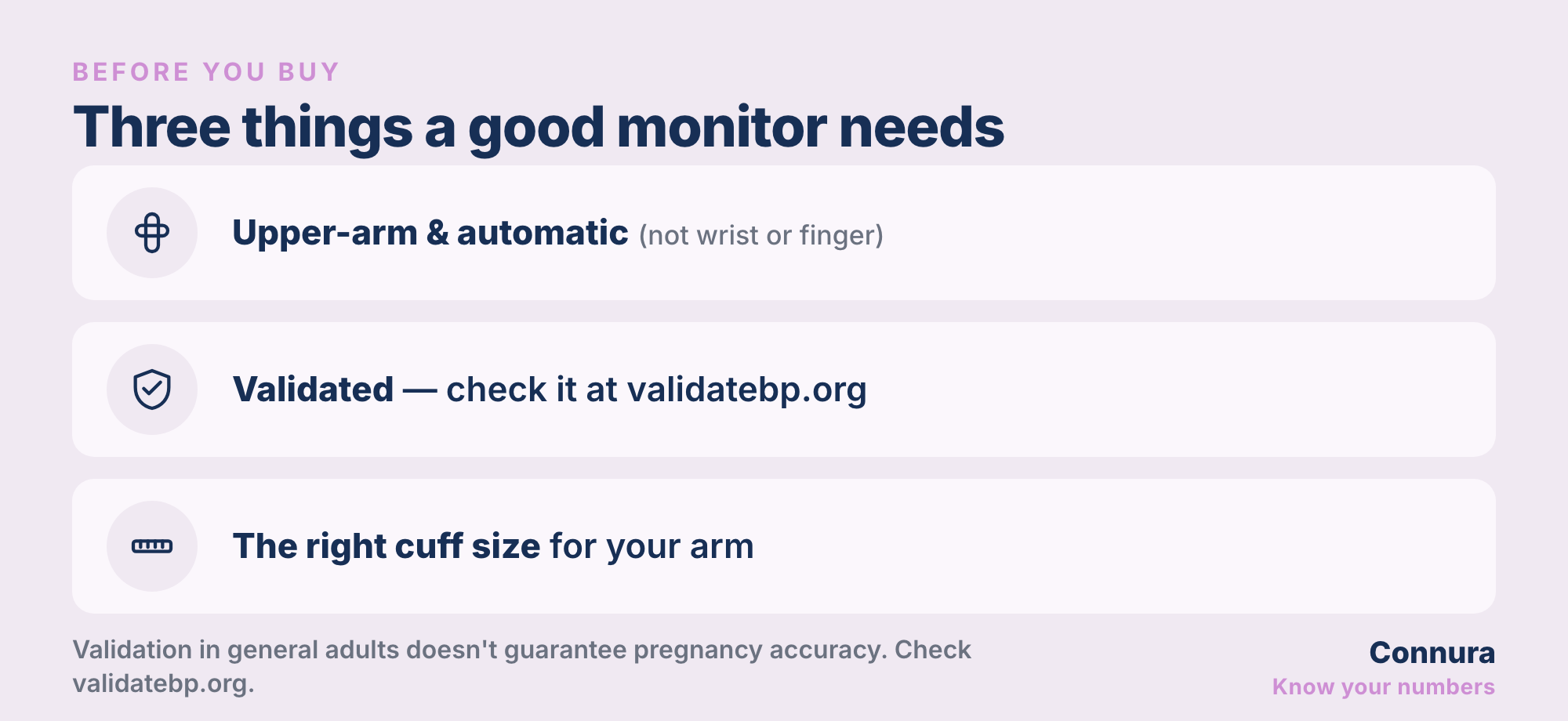
Start with the type of device. An upper-arm, automatic monitor is more accurate than wrist or finger monitors, which are more sensitive to hand position and tend to drift further from a true reading.¹ Skip anything that measures at the wrist or fingertip, even if it looks more convenient.
Next, check that it's validated: tested against a clinical standard and shown to measure accurately. You can look up any device by name at validatebp.org, the independent listing maintained with AMA and AHA involvement.² Validation is not a given: a review of home, clinic, and ambulatory BP devices found that only 9 of 28 examined, about a third, passed validation testing without any flagged issues.³ A device can look identical to a validated one and still not be one.
Finally, get the cuff size right. This is its own step, because it's the one most people skip.
Why Cuff Size Is Worth Getting Right
Blood pressure cuffs aren't one-size-fits-all. Don't assume the cuff that came in the box is the right size for you. The American College of Obstetricians and Gynecologists (ACOG) says an accurate cuff should measure 1.5 times your upper arm circumference, or be wide enough that the inner bladder encircles at least 80% of your arm.⁴
To find your size, wrap a soft tape measure around the midpoint of your upper arm (between your shoulder and elbow), with your arm relaxed at your side. Compare that number to the cuff-size range printed on the box or in the manual. Most monitors come with a standard cuff and offer a separate large-arm cuff; if your measurement is close to the edge of a range, size up.
Confirm It's Validated for Pregnancy Use
Validation testing in the general population doesn't automatically carry over to pregnancy. Blood vessels and blood volume change during pregnancy, so a device needs to be tested in pregnant women specifically to confirm it performs the same way. As one example of what that testing looks like: a 2018 validation study tested two Omron monitors against mercury-standard readings in pregnant women, including a subgroup with preeclampsia, and found both devices met the accuracy standard across the group.⁵ That's the kind of pregnancy-specific evidence to look for. Check validatebp.org for the current list of devices validated this way, rather than assuming any monitor on the shelf qualifies.
Setting It Up for an Accurate Reading
Once you have the right monitor and cuff, technique makes the difference between a reading you can trust and one that's just noise:
- Sit upright, feet flat on the floor, back supported, arm resting at heart level (a table or armrest works).
- Rest for at least 10 minutes before measuring, and avoid caffeine or tobacco for 30 minutes beforehand.⁴
- Fit the cuff on bare skin, about one inch above your elbow. Two fingers should slide under it snugly: not loose, not tight.
- Stay still and quiet while it measures; talking or moving can shift the number.
- Read the manual once, start to finish. Every monitor has small quirks worth knowing before your first real reading.
If a Reading Looks Off
A single unexpectedly high reading is often technique, not a true change. Rest a few minutes in the position above, then take it again. If your home readings and clinic readings consistently look different from each other, that's worth raising with your care team. They can check your cuff size and technique together, or confirm the device itself is working as expected.
One exception to all of the above: a confirmed reading at or above 160/110, or any warning symptom, means contact your care team right away, whatever the number and whatever might have caused it.
Work With Your Care Team
Your care team sets the plan for what your readings mean and when to call. This guide is about making sure the numbers going into that plan are ones you can trust. If home and clinic readings ever diverge in a way that surprises you, that's a technique-and-device conversation worth having with them directly.
Once your monitor is set up, Connura, launching late 2026, will give you a simple place to log every reading and generate a report to share at your next appointment.
Frequently Asked Questions
Do I need a special blood pressure monitor for pregnancy?
You need a validated, upper-arm, automatic monitor: not necessarily a "pregnancy-specific" model, but one confirmed accurate in pregnant women. Check the device against the listing at validatebp.org before you buy, since general validation doesn't guarantee pregnancy accuracy.
How do I figure out what cuff size to buy?
Measure around the middle of your upper arm with a soft tape measure, then match that number to the cuff-size range on the box. ACOG recommends a cuff that's about 1.5 times your arm circumference, or wide enough to encircle at least 80% of your arm. Size up if you're near the edge of a range.
My home readings don't match my clinic readings: what should I do?
Occasional small differences are normal, but if it's a consistent, noticeable gap, bring it to your care team. They can check your cuff size, your technique, and your device together to figure out where the difference is coming from.
References
- American Heart Association. Monitoring Your Blood Pressure at Home. 2024. https://www.heart.org/en/health-topics/high-blood-pressure/understanding-blood-pressure-readings/monitoring-your-blood-pressure-at-home
- US Blood Pressure Validated Device Listing. validatebp.org (AMA/AHA). https://www.validatebp.org
- Hurrell A, Webster L, Chappell LC, Shennan AH. The assessment of blood pressure in pregnant women: pitfalls and novel approaches. Am J Obstet Gynecol. 2022;226(2S):S804-S818. doi:10.1016/j.ajog.2020.10.026
- American College of Obstetricians and Gynecologists (ACOG). Gestational Hypertension and Preeclampsia. ACOG Practice Bulletin No. 222. Obstetrics & Gynecology. 2020;135(6):e237–e260. doi:10.1097/AOG.0000000000003891. PMID: 32443079. https://www.acog.org/clinical/clinical-guidance/practice-bulletin/articles/2020/06/gestational-hypertension-and-preeclampsia
- Topouchian J, Hakobyan Z, Asmar J, et al. Clinical accuracy of the Omron M3 Comfort® and the Omron Evolv® for self-blood pressure measurements in pregnancy and pre-eclampsia — validation according to the Universal Standard Protocol. Vasc Health Risk Manag. 2018;14:189-197. doi:10.2147/VHRM.S165524. PMID: 30214220
Connura provides educational information. It does not measure blood pressure and does not replace medical care. In an emergency, call 911 (or your local emergency number).
Connura is not a medical device and is not intended to diagnose, treat, or replace medical care. Always consult your healthcare provider for medical advice.